Mastering Workload and Focus: A Strategic Prioritization Guide Using the Eisenhower Matrix
What is the Eisenhower Matrix?
The Eisenhower Matrix is a two-dimensional time management framework that helps you prioritize tasks, projects, and to-dos based on their “urgency” and “importance.” It is named after Dwight D. Eisenhower, the Supreme Commander of Allied Forces in WWII and the 34th President of the United States. Eisenhower used this systematic filter to manage his massive daily workload. This approach was later formalized by management guru Stephen Covey, becoming one of the most effective productivity tools in the modern business world.
At its core, the matrix prevents to-do lists (backlogs) from growing uncontrollably. By dividing tasks into four logical quadrants, it empowers you to make strategic decisions rather than reactive ones.
Press enter or click to view image in full size
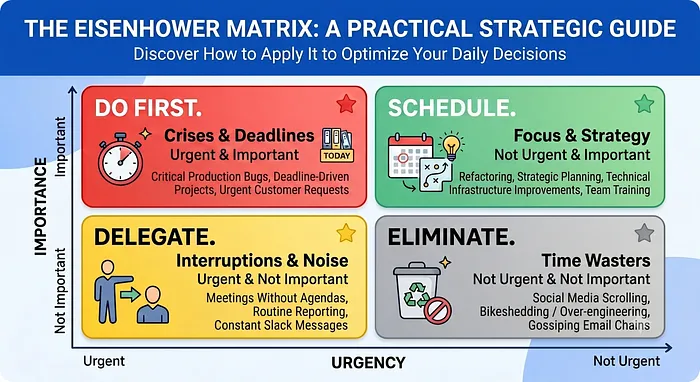
Eisenhower Matrix
What Are the Advantages of the Eisenhower Matrix?
Integrating this matrix into your workflow provides concrete benefits for both individual performance and team management:
- Provides Clarity and Prevents Chaos: It eliminates the ambiguity of what to tackle first among the dozens of tasks on your desk. It visually proves what truly matters.
- Reduces Decision Fatigue: Instead of pondering “Should I do this now?” for every new request, you can quickly assign an action (Do First, Schedule, Delegate, or Eliminate) based on the matrix’s rules.
- Builds a Proactive Work Culture: It saves you from constantly putting out fires (crisis management) and encourages you to dedicate time to strategic tasks that add future value to the product and project.
- Identifies Automation and Delegation Opportunities: It helps you clearly see which tasks require your specific expertise and which can be delegated to a teammate or automated by software.
Two Main Parameters: Urgency and Importance
The matrix requires you to evaluate every incoming task against two primary filters:
- Urgency: The time-sensitivity of a task. Failure to react immediately leads to a delay or a problem. Urgent tasks are usually external and force us to be reactive (e.g., fixing a broken integration, an approaching meeting).
- Importance: The task’s contribution to long-term goals, product vision, or team development. Though they might not yield immediate results, they are the tasks that create true value. They encourage us to be proactive (e.g., improving a process, designing a new architecture).
The 4-Quadrant Model: How Should You Manage Your Workload?
By intersecting these two parameters, the Eisenhower Matrix creates 4 distinct quadrants that dictate where you should spend your time and energy.
Quadrant 1: Do First (Urgent & Important)
Deadlines for critical projects, major bugs in the production environment, or urgent customer escalations fall into this category.
- Status: Cannot be delayed. Requires immediate action.
- Strategy: Complete them immediately. However, remember: if you spend the majority of your time constantly in this quadrant (crisis management), there is a serious flaw in your planning phase. In the long run, this leads directly to burnout.
Quadrant 2: Schedule (Important but Not Urgent)
This is the center of high-impact work and true productivity. These tasks don’t trigger immediate alarms, but they are vital for the future success of your project.
- Examples: Improving technical infrastructure, code refactoring, organizing training to boost team skills, or writing comprehensive product documentation.
- Strategy: Add them to your calendar and protect these time blocks from interruptions. Consistently investing in Quadrant 2 directly reduces the number of crises you will face in Quadrant 1 in the future.
Quadrant 3: Delegate (Urgent but Not Important)
These are “distracting” tasks that pull you away from your goals. They require quick reactions but offer no real contribution to your vision. They are often someone else’s priorities.
- Examples: Status meetings without a clear agenda, routine reporting, or constantly divided attention (e.g., instant messages).
- Strategy: Delegate. In the modern business world, “delegating” doesn’t just mean handing a task to a teammate; automation is the best method of delegation. Leave routine tasks to process automations or tools. AI may help you a lot here. Do not let other people’s agendas sabotage your focus.
Quadrant 4: Eliminate (Neither Urgent Nor Important)
These are zero-value situations that consume your time and energy while producing no output.
- Examples: Spending excessive time perfecting a minor detail (over-engineering), or gossipy email chains.
- Strategy: Remove them entirely from your to-do list (backlog). This is where you truly need to learn to say “No.”
How to Apply It in Practice
Understanding the theory is only half the battle. To turn the Eisenhower Matrix into a sustainable daily habit, follow these practical steps:
- The Brain Dump: Start by listing every pending task, bug fix, and feature request. You cannot prioritize what you cannot see. Get everything out of your head and onto a master list (or your Jira backlog).
- Be Ruthless with “Urgency”: When categorizing, question the true urgency of every request. If someone else marks a task as “ASAP,” evaluate if it aligns with your actual sprint goals. Not every loud notification belongs in Quadrant 1.
- Set WIP (Work in Progress) Limits: Do not overload your quadrants. Limit your “Do First” (Q1) to 2–3 critical tasks per day to maintain deep focus and avoid cognitive overload.
Conclusion: Transitioning from Busyness to Productivity
The Eisenhower Matrix is not just a to-do list; it is a decision-making and resource management system. When you pass tasks through this matrix instead of defaulting to “Yes” for every new request, you will see that the work you truly need to focus on reveals itself naturally.
If you want to take back control of your time, look at your list at the start of your next workday and ask yourself: Is what I am trying to do right now genuinely important, or is it just being made to feel urgent?
Please check out our “Getting Work Done Jira App” to plan “Your Day” in Jira.
References
- Stephen R. Covey (1989). The 7 Habits of Highly Effective People. (Specifically Habit 3: “Put First Things First”, the foundation of Q2-focused work).