What Is Getting Things Done (GTD©)?
Your to-do list keeps growing, notifications never stop, and your mind is constantly trying not to forget things. In modern work life, the…
Your to-do list keeps growing, notifications never stop, and your mind is constantly trying not to forget things. In modern work life, the real problem is often not a lack of time, but a lack of mental clarity.
This is where Getting Things Done (GTD) comes in. Developed by David Allen, GTD© is a productivity methodology designed not to make you work faster, but to help you work with a clearer and calmer mind.
“Your mind is for having ideas, not holding them” (David Allen)
When tasks, commitments, and unfinished work stay in our heads, they quietly create stress and reduce focus.
Why Use GTD?
GTD is widely used because it reflects how work actually happens: not in a neat, linear flow, but in interruptions, changes, and shifting priorities.
Using GTD helps you:
- Reduce mental overload
- Improve focus and decision-making
- Reduce procrastination
- Eliminate the constant “What was I supposed to do?” feeling
It is especially useful for knowledge workers, managers, entrepreneurs, and anyone juggling multiple responsibilities.
How Does Getting Things Done Work?
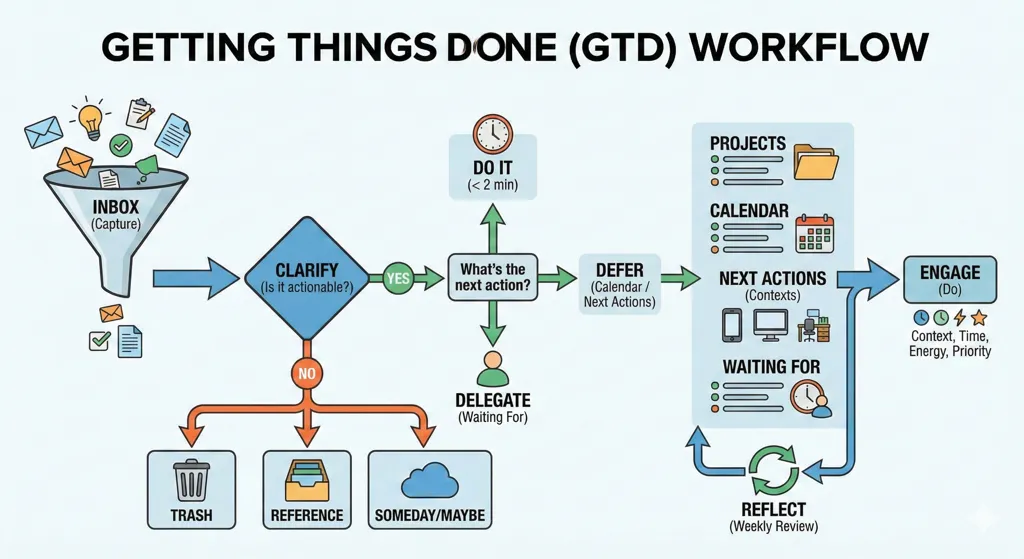
GTD is not about complex tools. It is about building reliable habits. A notebook, a notes app, or a digital task manager is enough. What matters is consistently applying the five core steps of the system.
1. Capture
Write down everything that has your attention (tasks, ideas, responsibilities) in one trusted place.
- “Email John”
- “Presentation idea”
- “Pay the bill”
- “Books to read”
At this stage, there is no organizing or prioritizing. The goal is to clear your mind and stop trying to remember everything.
2. Clarify
For each item you captured, ask one simple question:
“Does this require action?”
- No → Trash, reference, or Someday/Maybe
- Yes → Define the next concrete action
The key here is turning vague intentions into clear, physical actions.
❌ “Prepare presentation”
✅ “Write three main slide titles”
3. Organize
Organizing is the backbone of GTD. The goal is not to prioritize, but to place each item into the right context, so decisions become easier later.
- Next Actions
These are single, concrete tasks that are ready to be done.
- “Send meeting notes to Emily”
- “Write presentation headings”
- “Pay the invoice via banking app”
This list removes decision fatigue.
- Projects
Any outcome that requires more than one step is a project.
- “New website”
- “Moving to a new apartment”
- “Annual report”
Projects are not things you do directly. You complete next actions, which move projects forward. Every project should always have at least one defined next action.
- Waiting For
Items you are waiting on from someone else.
- “Proposal from Harry”
- “Approval from accounting”
- “Package delivery”
This list prevents unnecessary stress and helps you follow up at the right time.
- Calendar
The calendar is only for tasks that must happen at a specific date or time.
- Meetings
- Deadlines
- Time-specific commitments
Tasks that can be done “anytime” do not belong here.
- Someday / Maybe
Ideas and commitments that are not active right now, but not discarded either.
- “Start a podcast”
- “Learn a new language”
- “Build my own business”
This list gives ideas a safe place without letting them distract you.
4. Reflect
The step that keeps GTD alive is the weekly review.
Once a week:
- Review all lists
- Clear completed items
- Check project status
- Capture anything new
This habit keeps your system trustworthy, so your mind can relax.
5. Engage
At this point, you no longer need to decide what to do.
You choose actions based on your time, energy, and current context.
GTD does not ask, “What is the most important task?”
It asks: “What is the best action I can take right now, given my circumstances?”
Conclusion
Getting Things Done is not about doing more work.
It is about working with less stress and more clarity.
You don’t need to apply the system perfectly. Start small, adapt it to your life, and build consistency over time.
Please note that GTD® and Getting Things Done® are registered trademarks owned by The David Allen Company. This content is an independent guide and has not been authorized, sponsored, or endorsed by The David Allen Company.