A Practical Way to Overcome Focus Problems: The Pomodoro Technique
You sit at your desk. You have a task to do, but your hand keeps reaching for your phone. A few notifications, a bit of scrolling through…
You sit at your desk. You have a task to do, but your hand keeps reaching for your phone. A few notifications, a bit of scrolling through social media, and time just slips away. For many of us today, staying focused on a single task for a long period is a highly challenging process.
If you often leave your desk at the end of the day feeling like, “I worked constantly today but didn’t actually finish anything,” it might be time to meet a simple method that will change how you work: The Pomodoro Technique.
What is Pomodoro and Where Did It Come From?
“Pomodoro” means tomato in Italian. In the late 1980s, a university student named Francesco Cirillo noticed he was getting easily distracted while studying. He started with a simple challenge to himself: “Can I work for just 10 minutes without any interruptions?” To track the time, he used a tomato-shaped kitchen timer.
Over time, Cirillo developed this small experiment and discovered that the ideal duration for the human mind to focus without fatigue was 25 minutes. This personal solution gradually evolved into a standard time-management tool used by millions today.
What is the Main Purpose of the Pomodoro Technique?
Many people assume this technique is just a tool to “work non-stop like a robot” or “cram more tasks into a day.” However, the real purpose is to fix our stressful relationship with time. When developing this system, Cirillo focused on three core objectives:
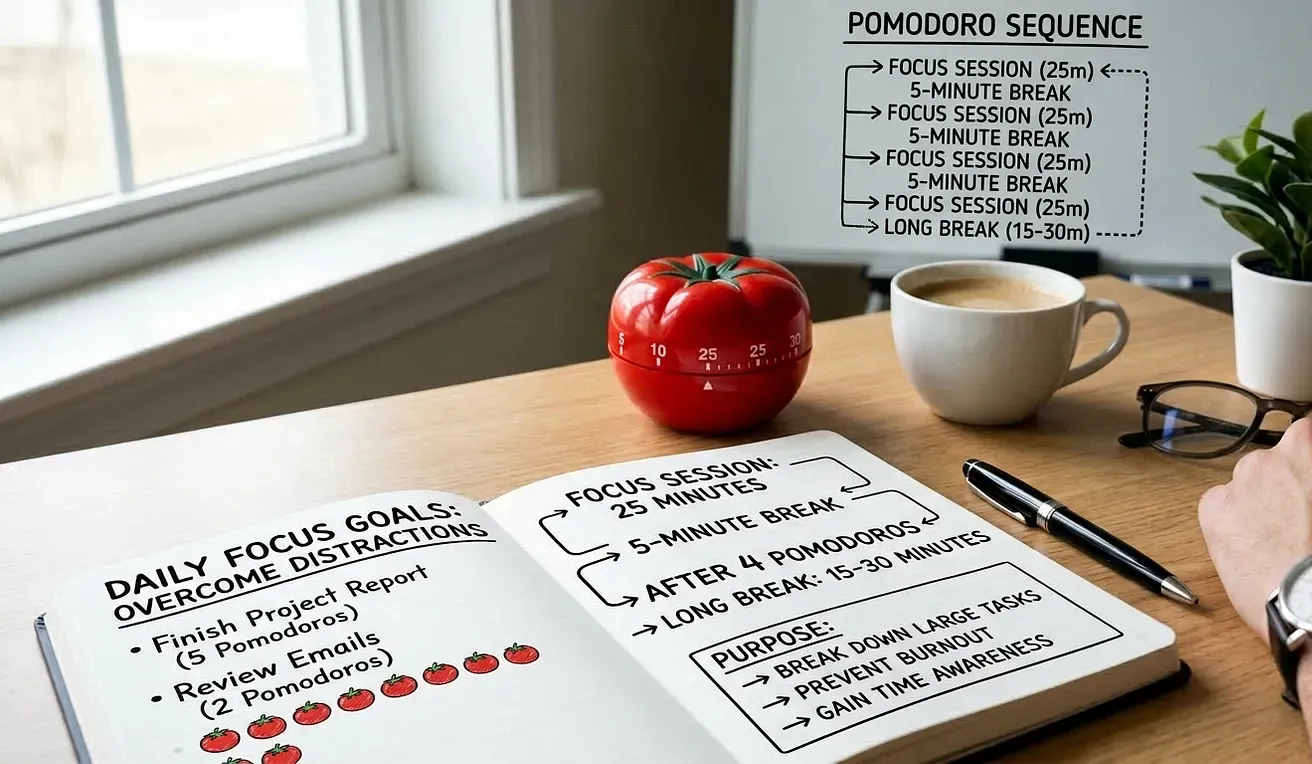
- Alleviating anxiety: Breaking down intimidating, complex, and large tasks into 25-minute chunks to eliminate the stress of starting.
- Preventing mental burnout: Making regular breaks a strict rule to prevent overloading the brain and to reduce that end-of-day feeling of exhaustion.
- Gaining time awareness: Being able to measure how long a task actually takes compared to our estimates. (For example, being able to say, “Writing this report took exactly 4 Pomodoros” makes your future time planning much more realistic.)
How Does the System Work?
To practice the Pomodoro Technique, you only need a timer and a clear task to do. The steps are as follows:
- Define your task: Be clear about what you are going to work on.
- Set the timer to 25 minutes: This 25-minute period is called “1 Pomodoro.” During this time, there are no phones, messaging apps, or other internet tabs; focus solely on the task at hand.
- Take a 5-minute break: When the time is up, stop working and rest for 5 minutes. Instead of looking at a screen, stand up, drink some water, or move around a bit.
- Take a long break: Once you complete this cycle of 25 minutes of work and 5 minutes of rest four times (about 2 hours), give yourself a longer break of 15–30 minutes. This is necessary for your mind to recover.
Why Does This Method Work?
The logic behind Pomodoro’s effectiveness is quite practical:
- It breaks the resistance to start: A massive task waiting on your desk that will take hours is intimidating, so you keep putting it off. Pomodoro, on the other hand, only asks you to “deal with this task for 25 minutes.” A 25-minute commitment feels much more doable to the mind.
- A clear finish line motivates you: Working for open-ended hours is exhausting. But the awareness of “I only have 8 minutes left, then I’ll rest” makes it easier to stay at your desk.
- Time constraints sharpen focus: Knowing that time is specific and limited prevents you from getting lost in unnecessary details. It allows us to evenly distribute that natural state of focus we experience right before exams or deadlines throughout the day.
Things to Watch Out For (Cirillo’s Basic Rules)
In his book detailing the method, the creator of the system, Francesco Cirillo, specifically highlights the management of interruptions for the technique to be successful. According to Cirillo, there are two types of interruptions, and you should deal with them like this:
- Internal Interruptions: If thoughts like “I need to pay the bill” or “I should reply to that email” suddenly pop into your mind while working, don’t stop the process. Cirillo recommends writing these thoughts down on a piece of paper immediately (thus getting them out of your mind) and quickly returning to your current task.
- External Interruptions: When someone approaches you to ask a question or make a request, do not stop the timer. Make it a habit to protect your process by saying, “I’m in the middle of a task right now, I’ll get back to you in 15 minutes.”
Additionally, working on a computer for 25 minutes and then looking at social media on your phone during your 5-minute break does not rest your mind. Try to spend your breaks away from screens.
Conclusion
Focus is not a magical talent; it is a habit acquired through practice. The Pomodoro Technique is a free and simple tool you can use to build this habit. Next time you sit down to work, instead of procrastinating, set your timer to 25 minutes and just start. The rest will come easier than you think.
Please check out our “Getting Work Done Jira App” to plan “Your Day” in Jira.
Bibliography
- Cirillo, F. (2018). The Pomodoro Technique: The Acclaimed Time-Management System That Has Transformed How We Work. Currency Publishing.